

A conversation on research, influence, and complexity with researcher Dr. Sid Mohandas
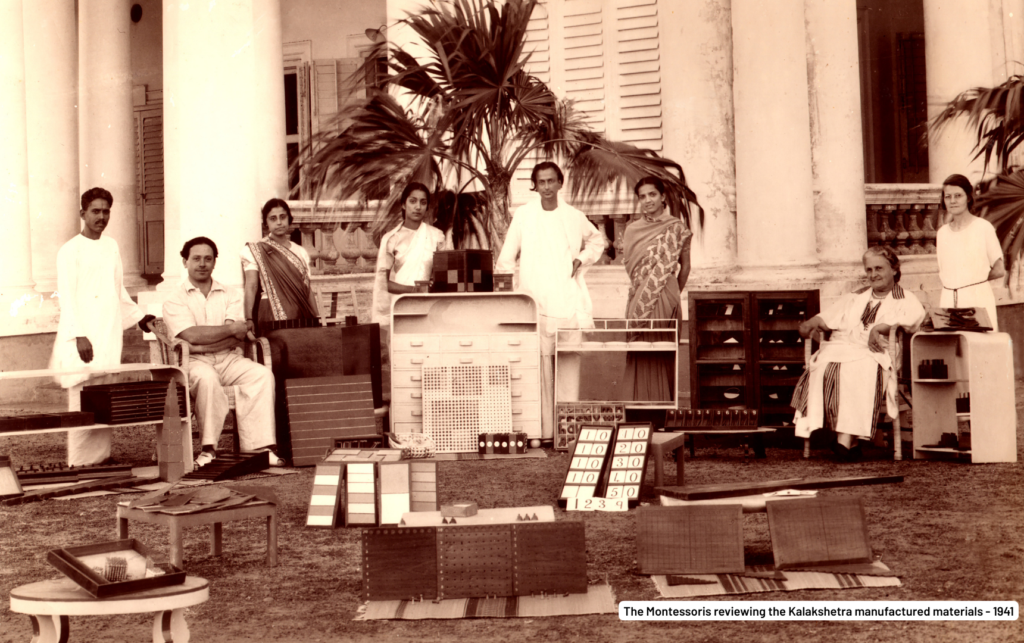
This year, as part of The Montessori Event conference in Washington, D.C., attendees will relive a remarkable era in Maria Montessori’s intellectual journey through an extended exhibit hall experiential walkthrough. Anchored by a researched, interactive, museum-style timeline installation of Montessori’s journey in India, the walkthrough highlights key milestones, including her collaborations with leaders and thinkers and the creation of her transformative educational practices, which remain central to Montessori schools today. To better understand the process and research that went into the timeline of Montessori’s journey, we interviewed Dr. Sid Mohandas, a Montessori practitioner and childhood studies scholar who put together the research for the timeline.
What sources or discoveries really helped you piece together Montessori’s time in India? Were there any that changed the way you saw this chapter of her life?
Dr. Sid Mohandas: The sources that informed the installation are wide-ranging and include both primary and secondary materials. These range from Montessori’s personal letters to her grandchildren (Montessori, 2020), publications and pamphlets produced by the Theosophical Society, newspaper clippings from the period, and broader historical literature documenting India during the 1930s and 1940s. I am also deeply indebted to the work of Indian Montessorians such as Rukmini Ramachandran, whose work has been crucial in preserving this history, especially the immense amount of work that went into translating, contextualising, and publishing the 1939 Adyar lectures, titled Creative Development in the Child Vol I and II. I’m also grateful to scholars like Carolie Wilson, Jana Tschurenev, and Mira Debs for offering more nuanced perspectives on Montessori’s time in the subcontinent. In particular, Wilson’s 1988 thesis is perhaps the most exhaustive account of Montessori’s time in the subcontinent, which I am pleased to hear has now been published as a monograph titled ‘Exploring the Roots of Montessori in India’.
I should also note that the installation extends beyond postcolonial India, to include Montessori’s time in what is now Pakistan (which, prior to 1947, formed part of British India) as well as Sri Lanka. In this context, the book The Age of Miracles is an important text, as it brings together the lectures Montessori delivered in Sri Lanka while also offering insight into the historical formations and developments of the nation during that period.
One particularly valuable resource was Joel Parham’s online archival platform, montessoribib.org, which brings together dispersed documents and references that would otherwise be very difficult to access. What these sources collectively did was challenge the often-romanticized narrative of Montessori’s time in India and instead reveal it as a period marked by tension, contradiction, adaptation, and uneven power relations.
How did Montessori’s connections with the Theosophical Society and other thinkers in India influence the ideas she developed during those years?
Dr. Sid Mohandas: It was George Arundale, then President of the Theosophical Society in India, and his wife Rukmini Devi, who played a central role in bringing Montessori to India. We know from the work of Carolie Wilson (1985) that Montessori became a member of the Theosophical Society as early as 1899, just a year after Mario Montessori Sr. was born. Yet, interestingly, in her later correspondence and public responses, Montessori appeared keen to distance herself from being described or identified as a Theosophist.
That said, it is difficult to deny that her prolonged time in India, living among and working with Theosophists like Rukmini Devi and Sarladevi Sarabhai, had a profound influence on her thinking. Her ideas around Cosmic Education, in particular, seem to have been strengthened and deepened during this period. We also see a noticeable shift from a predominantly Western scientific modernist framing of the child towards a more spiritual and mystical conception of childhood. This shift is often overlooked in contemporary Montessori discourse, which tends to repackage Montessori as a purely Western scientific figure, stripped of these spiritual and philosophical influences.
It’s worth highlighting that Montessori spent considerable time observing and learning from Indian mothers and children. We are told that she would sit in her car in the bazaars in Kodaikanal, observing mothers carrying their babies on their hips wherever they went. When she comes back to Europe, you see her mention this in her lectures again and again, and her book The Absorbent Mind, as well as the Montessori birth-to-three curriculum,materialised primarily from these observations. So it’s not just key Indian thinkers or the Theosophical Society that influenced Montessori’s views, the everyday mundane life profoundly shaped the ideas developed during those years.
Your personal research lens draws on feminist and decolonial/anticolonial perspectives. How did these guide the way you explored Montessori’s time in India?
Dr. Sid Mohandas: A feminist lens has been crucial in situating Montessori’s earlier involvement in the suffragette movement within its broader political and historical context. It allows us to see Montessori as a political actor navigating male-dominated scientific and educational spaces.
Decolonial and anticolonial perspectives, meanwhile, help locate Montessori’s work within wider colonial relations of power. They allow us to grapple with the complexities of her position in British-ruled India. Montessori herself was not explicit about involvement in national liberation movements, and her status as an “enemy alien” as an Italian citizen in British India further complicated her political positioning. Yet many of those drawn to her work, overwhelmingly elite Indians, were invested in using her approach for nation-building purposes. At the same time, this elite-led model has been criticised for advancing only a perception of decolonisation, a transfer of power in which colonial infrastructures and ways of being and knowing largely remained intact. My research highlights how the very conception of ‘human’ embedded in Montessori education is a colonial one that is core to its civilising mission. I try to attune to these aspects in the way I have developed the content.
Montessori trained hundreds of teachers while in India—how do you think that experience helped shape Montessori education in India?
Dr. Sid Mohandas: Mira Debs (2022) has written extensively about the development of Montessori education in India following independence from British colonial rule. One of the key factors shaping this trajectory was the growing tension between Montessori and the Theosophical Society. The Montessoris’ work in India was heavily funded by the Society under the leadership of the Arundales, yet by 1948, they received a message from the Society informing them that funding would be withdrawn as they were unable to sustain the exorbitant salaries. This played a pivotal role in the decline of the Montessori movement in India in the postcolony.
Historically, we see two competing routes to development. One insisted on a purist, top-down reproduction of Montessori as conceived by the Montessoris themselves. This is seen in the work of Maya Devi Balachandra, who established a Montessori preschool (Shishu Vihar) in Yavatmal (Maharashtra). Balachandra experimented with the method in rural India, insisting on maintaining fidelity to the rigorous standards of AMI. The other approach, as seen in the work of Tarabai Modak, sought to Indianise the approach, that is, adapt the approach to the social, cultural, and material realities of different local communities, especially the Dalit people (caste-oppressed) and Adivasi people (Indigenous groups). Modak’s approach was met with indifference or disapproval from Montessori. I believe these dynamics may have shaped how Montessori education spread, or failed to spread, in India, and as Debs (2022) writes, the long-term impact of Montessori education depends on the adaptation of the method to the needs of the locals.
Did anything you uncovered during your research surprise you or challenge what you previously believed about Montessori’s decade in India?
Dr. Sid Mohandas: I wouldn’t say it entirely surprised me, but it was striking to see how the same tensions around the “purity of the method” that appear elsewhere in Montessori’s global travels also surface very clearly in her time in India. These tensions persist today and were, even then, a source of criticism from local figures, including Gandhi. When Gandhi criticised Montessori’s approach as being far removed from the everyday life of Indians, and requested for it to be adapted, her response was ‘I am not a tailor. I have produced the cloth. If you want to wear it in a special way in India, it is for your teachers to cut it according to their taste.’ (Montessori, in Hennessy, 1955, p.162).
Another aspect I found particularly compelling was how quickly Montessori seemed to pick up on caste hierarchies and practices. Reading her letters to her grandchildren, one immediately encounters racist views about Indians, but alongside this are acute observations about caste, purity laws, and the social hierarchies they produce. The fact that many of those who championed the approach came from “upper-caste” or savarna Hindu communities adds another layer of exclusion that deserves closer scrutiny.
What do you hope visitors walk away with after going through this immersive exhibit? How do you want it to influence their practice moving forward?
Dr. Sid Mohandas: There are, of course, lighter moments and intriguing details in the content of the installation, such as Montessori bathing five times a day when she first arrived in Adyar, or her fondness for drinking lemonade or coffee throughout the day and never water. My deeper hope is that the installation transfers a sense of affect, a felt experience of Montessori’s time in India.
I want visitors to carry that feltness with them, to sense the tensions of internment, the difficulties of acclimatising to the cultural context, and the immense diversity of lived experience that is India. More than acquiring facts, I hope attendees leave with a more complex, inspired, and unsettled understanding of Montessori, one that invites reflection, responsibility, and a willingness to question how Montessori education is practised today.
References:
AMI Communications (1968) Mario Montessori on G.V. Subba Rao. p.12
Arundale, M. (1942) Dr Montessori in the Mountains. The Theosophical Worker, 7(7) (July)
Association Montessori Internationale (2005) Maria Montessori 1870-1952: An Anthology. Amsterdam, The Netherlands: AMI.
Debs, M. (2022). Montessori in India: Adapted, competing, and contested framings, 1915–2021. History of Education Quarterly, 62(4), 387-417.
Hennessy, J. (1955). India’s democracy and education: a study of the work of the Birla Education Trust. Orient Longmans.
Kahn, D. (1988) Kahn-Montessori Interview: The Kodaikanal Experience, Part II, NAMTA Journal, 13(2), pp.19-24
Kahn, D. (2013) Kahn-Wikramaratne Interview: The Kodaikanal Experience, Part I, NAMTA Journal, 8(1), pp.81-91
Montessori, M. (1941a) A Step Forward Towards The Future: The Social Party Of The Child. The Theosophist, 62(8) (May)
Montessori, M. (1941b) Homage to Dr. Rabindranath Tagore. The Theosophist, 63(1)
Montessori, M (1942) Reconstruction of Education. The Theosophist, 63(5), pp.355-361
Montessori, M. (1943) cited in The Young Child, 18(1), p. 2.
Montessori, M. (1946). Education from Birth, The Theosophist, March, 1946, p. 252
Montessori, M. (1947) ‘Reception To Dr. Maria Montessori’, The Hindu (Madras), 8 August, p.8
Montessori, M. (1955). To Educate the Human Potential. Madras: Kalakshetra Press.
Montessori, M. (1962). Peace and Education. Madras: Theosophical Publishing House.
Montessori, M. (1989). Creative Development in the Child Volume I. Madras: Kalakshetra Press.
Montessori, M. (1998). Creative Development in the Child, Volume II. Madras: Kalakshetra Press
Montessori, M. (2003). The Child. Amsterdam, The Netherlands: AMI.
Montessori, M. (2013). Exercises of Practical Life: 3 to 6 Compared to 6 to 12, The NAMTA Journal, 38(1), pp.53-58
Montessori, M. (2019). The Age of Miracles. Mumbai: Indian Montessori Foundation
Montessori, M. (2020). Maria Montessori Writes to Her Grandchildren, Letters from India, 1939-1946. Amsterdam: Montessori-Pierson Publishing Company
Ramachandran, R. (2021). 1939-1949 – Montessori in India: A lasting legacy, Supraja Montessori Study Centre. Available at: https://suprajamontessori.org/1939-1949-montessori-in-india-a-lasting-legacy/ (Accessed: 30 August 2025).
Ramachandran, R., & Debs, M. (2023). Montessori Education in India. The Bloomsbury Handbook of Montessori Education, 365.
Reuter (1949, May 27th) Dr Montessori, The Times of India, p.5
Sri Ram, N. (1941) On The Watch-Tower. The Theosophist, 63(1)
The Nobel Prize (2025): Maria Montessori. Available at: https://www.nobelprize.org/nomination/archive/show_people.php?id=6383 (accessed on 20/08/2025)
The Times of India (1949, April 10th) Dr M Montessori Name Suggested for Nobel Peace Prize, The Times of India, p.10
Trabalzini, P. (2011). Maria Montessori Through the Seasons of the “method”, NAMTA Journal
Tschurenev, J. (2021). Montessori for all? Indian experiments in ‘child education’, 1920s–1970s. Comparative Education, 57(3), 322-340.
Wilson, C. (1985). Montessori was a Theosophist. History of Education Society Bulletin, 36, pp.52-54
Wilson, C. E. (1987). Montessori in India: A study of the application of her method in a developing country (Doctoral dissertation, University of Sydney).