

The Beginning of a Lifelong Fascination
Long before Darla Miller discovered Montessori education, she was already captivated by one central question: How do children grow and learn?
She traces that curiosity back to childhood itself. When Darla was 12 years old, her youngest sister was born, and her mother deeply involved her in caring for the baby.
“I think that started my lifelong fascination with how young children learn and grow,” Darla reflects.
As a college student at Baylor University in the mid-1960s, she studied education and minored in art, eventually earning credentials to teach art across grade levels. Yet even then, something felt incomplete in her coursework.
“I learned a lot of content about teaching,” she says, “but there wasn’t much about development and the other side of human growth besides intellectual learning.”
One memory from that period stayed with her for decades. Searching the university library for information about infants, she discovered there was virtually nothing available. “I looked up ‘infant’ in the card catalog,” she recalls. “There was no card. No card on baby.”
Eventually, she found a single child development text with only a few pages dedicated to infancy. One line in particular unsettled her deeply: a newborn infant, the book claimed, was “inept” and would stare at a lightbulb as easily as its mother’s face.
Years later, after the birth of her first daughter, Darla’s understanding shifted completely.
“When she was born, I held her there moments after her birth in the delivery room, and looked at her and she opened her eyes and looked at me in the eyes,” Darla remembers. In that moment, she realized how little she truly knew.
That realization launched a new path of study and discovery.
Around that same time, researcher Burton White began publishing groundbreaking work on infant and toddler development, including the influential book Birth to Three. His research echoed what Maria Montessori had said decades earlier: the first three years of life are not a passive period of custodial care, but one of the most significant stages of human development.
“That lit the fire,” Darla says.
Soon afterward, she discovered Montessori’s The Secret of Childhood and other writings. Darla knew this was her passion. This is what she was called to do.
Building Montessori for a Changing World
Around 1973, Darla began working as an assistant in one of the earliest Montessori schools in Houston alongside her friend Margaret Ellison, a fellow public school educator.
At the time, the school offered a Montessori morning program, but families increasingly needed full-day care as more women entered the workforce.
“The school didn’t really know what to do,” Darla says.
She and Margaret quickly recognized that families needed something deeper than afternoon babysitting; they needed Montessori all day.
With that insight, Darla and her colleagues helped pioneer a new model: full-day, year-round Montessori education grounded in continuity, consistency, and respect for the child throughout the entire day.
Together with AMS mentorship and support, they helped establish programs staffed from 7 a.m. to 6 p.m. by Montessori-credentialed educators—not rotating caregivers or custodial staff.
These programs became enormously sought after.
“There were hundreds of people on waiting lists,” Darla remembers. Margaret affectionately called it “the sparkle in the eye list”—families who weren’t even expecting yet, but already wanted a place reserved for their future child.
Darla helped open Montessori schools in Houston that continue to serve children and families more than 50 years later.
But from the beginning, she had one condition.
“I told Margaret, ‘I’ll help you open them if you let me do babies.’”
Creating Something Entirely New: Montessori for Infants & Toddlers
At the time Darla began this work, there was no Montessori infant-toddler credential pathway as we know it today. The field itself was still being created.
Among the early leaders shaping infant and toddler Montessori education were Virginia “Ginny” Varga, Carole Korngold, and Maria Gravel—women Darla still refers to as “the founding mothers” of infant and toddler Montessori credential development.
“We were experimenting and trying to see what worked and finding our way,” Darla says.
The pioneers in the field were developing the work in real time.
One early philosophical divide centered around whether infant and toddler Montessori should merely be a simplified version of the 3–6 classroom.
“One approach was: how do we take 3–6 and water it down for infants and toddlers?” Darla explains.
But another vision emerged—one championed strongly by Maria Gravel and embraced by Darla and her colleagues.
“Infant and toddler was not watered-down 3–6,” Darla says. “It was its own thing.”
That perspective ultimately shaped the direction Montessori infant and toddler education would take over the next half-century.
Today, Darla says it is deeply moving to witness how refined and sophisticated infant and toddler Montessori environments have become.
“We’ve come so far in half a century,” she reflects. “It’s amazing to have witnessed that magical evolution.”
Sensitive Moments: Understanding the Youngest Child
Darla’s work has always been grounded in developmental theory and close observation of children.
“That’s what excites me,” she says. “The process of figuring stuff out.”
She describes infant and toddler Montessori education as deeply rooted in understanding how development unfolds moment by moment.
“How do children develop object permanence? How does language development happen? They’re changing so rapidly.”
While Montessori educators often speak of “sensitive periods,” Darla describes infancy and toddlerhood in even more immediate terms.
“We talk about sensitive moments,” she explains. “They may be fascinated by something today, trying to figure out how to do it, and tomorrow they’ve moved on.”
“If you miss those sensitive moments because you didn’t notice what they were trying to learn,” she says, “then you can’t really meet their needs.”
This requires adults who are flexible, observant, and responsive. Prepared adults, as Dr. Montessori said, who can think on their feet and adapt alongside the child.
Supporting Families with Respect and Confidence
For Darla, Montessori work has never been limited to the classroom alone.
“Being a parent is hard,” she says honestly. “You’re learning on the job, making all kinds of mistakes.”
She speaks compassionately about the guilt many parents carry and the deep love that drives them to seek the best for their children.
“There isn’t anything in the world we care more about than our children.”
Her goal has always been to help parents feel more confident and intentional.
“I want parents to trust their gut,” she says. “If something doesn’t feel right, then you need to think through why.”
Rather than prescribing rigid formulas, Darla encourages thoughtful, reflective parenting rooted in observation, connection, and respect.
This philosophy also shaped her writing.
While teaching early childhood and Montessori courses at the college level, a textbook representative once approached her about adopting a child discipline book for her classes. Instead, Darla launched into what she laughingly describes as her “Montessori soapbox,” explaining why she could never support approaches based on rewards, punishments, or manipulation.
A few days later, the representative called back with an unexpected proposal: would she write a new book instead?
The result was Positive Child Guidance, a text grounded in Montessori philosophy and humanistic education. The book found a wide audience and continues to be used internationally today, now in its ninth edition and translated into multiple languages, including Portuguese and both traditional and simplified Chinese.
Expanding Montessori Through Higher Education
Darla’s educational journey continued alongside her Montessori work. Encouraged early on by a fellow Montessori educator, she pursued graduate study while balancing family life and professional work.
She went on to earn her doctorate from the University of Houston and moved into higher education leadership, teaching at universities and community colleges before ultimately serving as a community college vice president.
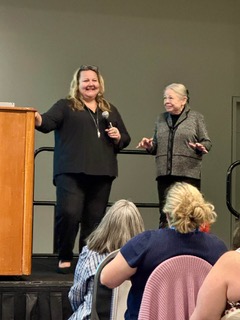
Throughout these roles, Darla remained deeply committed to making Montessori educator preparation more accessible. Influenced by early Montessori leader Nancy Rambusch and her vision of expanding Montessori beyond affluent part-day programs, Darla believed community colleges could become powerful homes for Montessori teacher education programs.
Community colleges, she believed, offered supports many adult learners needed: tutoring, language assistance, libraries, and affordability.
“For many students coming into Montessori educator preparation…community college is rich with resources,” she explains.
International Work: Montessori Across Cultures
After retiring to care for her husband during his illness, Darla entered yet another chapter of her Montessori journey.
Following his passing in 2011, she began traveling internationally to support Montessori educator preparation programs throughout Asia. Her work expanded into China, Vietnam, Taiwan, Malaysia, South Korea, and beyond—partly through the growing international reach of Positive Child Guidance.
What she found there deeply moved her.
Darla speaks with admiration about the sacrifices many Asian families make for their children’s education. “Parents there are probably more committed than almost any culture on earth to education as the source of their children’s security,” she says.
She also witnessed young parents actively seeking alternatives to harsh or humiliating disciplinary systems they themselves experienced growing up.
“These young parents are saying, ‘My education was rigid and harsh,’” Darla explains. “They want something different for their children.”
Again and again, she saw families connect deeply with Montessori’s emphasis on dignity, respect, and peaceful human relationships. “It’s amazing,” she says, “to see young parents connect to the philosophy of Montessori and the whole idea of respect and democracy.”

The Cosmic Task
Now 80 years old, Darla continues to travel, teach, mentor, and support Montessori initiatives around the world.
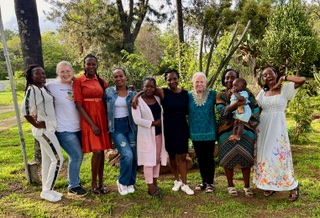
She is planning another trip this summer to China and Malaysia and is also currently involved in work with AMS in Zimbabwe focused on expanding Montessori infant and toddler education beyond classroom settings into family coaching, prenatal and postnatal support, and broader community care.
For Darla, the work has always been larger than schools alone. Throughout her life, she has worked to expand Montessori outward: first through infant and toddler environments, then through higher education, community colleges, international educator preparation, and now family-centered support systems around the world.
Reflecting on that lifelong expansion of Montessori’s reach, Darla smiles and says simply: “That’s [my] Cosmic Task! That’s it!”