

The American Montessori Society (AMS) is kicking off the 2026 Regional Labposium, Prepared and Ready: Montessori Meets the Moment, in Houston, Texas, before making four additional stops across the country. Designed to meet Montessori educators and leaders where they are, this dynamic professional learning experience will create a space for Montessorians to thoughtfully reflect on the enduring relevance of Montessori education and the role of the prepared adult in guiding children within a changing world.
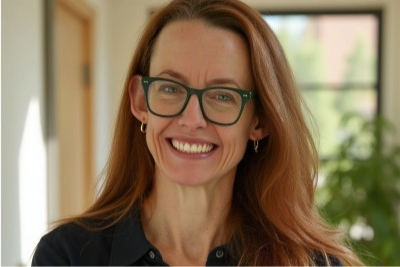
One of this year’s speakers is Samantha Gleisten, who will be leading the session “Montessori in the Age of AI.” Samantha serves as the Innovation Studio and Digital Citizenship Coordinator at Rogers Park Montessori School in Chicago, where she works at the intersection of Montessori philosophy, AI literacy, and digital citizenship. She has presented and written widely on the prepared adult’s role in a rapidly changing technological landscape, and brings to this work both the grounded perspective of a practicing Montessorian and the conviction that this moment calls us to something specific: to recognize what Montessori has always offered, find the language to articulate it clearly, and do the interior work to speak from it with honesty.
We spoke with Samantha about the upcoming Regional Labposium, and she shared her insights on her professional journey, the inspiration behind her presentation, and her perspective on the future of Montessori education.
Can you give us an overview of what you will discuss during your sessions? What should attendees expect, and what are your key takeaways?
We’ll start with some real honest information and conversations about AI and the world in which our children are growing up. While of course, there are a lot of amazing opportunities created by technology and AI, we also have to understand how these technologies reshape and affect the environments our children are growing up in. There are real benefits and real costs to understand. From there, it isn’t about “AI coming” for anything or anyone, but rather about the conditions we know children need for development and flourishing, such as sustained attention, agency, independent thought. What pressures are those facing and how can we respond within our teaching practice as Montessorians? This is an area where we have a lot to offer the child and educational practices at large. We will really spend some time tracing and understanding how Montessori— from the three-hour work cycle, to our understanding of the Elementary student’s growing capacity for reasoning, and the adolescent’s capacity for cognitive liberty are exactly what this moment demands. Later, we will spend time imagining the world we want for our children and then actively building the resources to communicate that with the stakeholders and constituents we serve.
Attendees will leave with a greater understanding of how their practice, and their understanding of child development, connects to the specific pressures of an AI-shaped world. They will also create at least one concrete resource or action for their own classroom or leadership work.
Why is a topic like “Montessori in the Age of AI” relevant for Montessori educators today?
We can’t prepare children for a world we don’t understand ourselves, and right now, a lot of us are avoiding that world rather than looking at it honestly. I see a lot of people, educators included, splitting into camps: adopt the tools or reject them. And the reality is that this is not a binary and neither of those approaches is really engaging with what’s happening to kids’ attention, agency, and capacity for independent thought. As Montessorians, we have been practicing the work that a lot of educators and researchers are currently writing about and naming. Our pedagogy is designed in support of the fundamental skills and ideas—things like cognitive liberty, independent thought, and relational intelligence—that now people are naming as essential. We have so much to offer as Montessorians in this moment. When we can see those connections between the world we are preparing our children for and how our child-development-focused pedagogy is what will best support the child in the age of AI, we can better communicate that to parents and community members and ultimately, better serve and support our students.
How do you continue to learn and stay inspired in your own work?
For years in my 9-12 classroom the words, “You’re Never Done” would end up on our class peace promise. Students had heard my co-teacher and me say it so many times that it became part of the culture of the room. Learning isn’t something that ends, not at graduation, not at any age. I’ve been in Montessori education for almost 20 years now, and what I found in my personal transformational process as a Montessori educator is that as I’ve focused on attuning my observation skills, everything becomes inspiring. I feel like this is another area that our pedagogy has so much to offer in education at large. Observation is really a pathway to discovery, and if your work is all about discovering things all the time, that’s a pretty inspiring path!
Montessori education continues to evolve. What excites you most about where the movement is heading?
I have the good fortune to know a lot of educators both within and outside of Montessori, and what excites me is that educators outside of Montessori are looking for a holistic educational approach based in human development. As we shift our perception of learning from recollection of facts to an ability to deeply ponder, make interesting connections across domains, and relate to others, Montessori emerges as an approach that centers all of this. And this is why, as AI exposes what is broken in so many educational systems, we see Montessori bubbling up as a movement with a solution and a path forward for educators, and more importantly, our students. That’s what excites me; that’s my North Star.
We invite you to join us at the 2026 Regional Labposium to hear more from Samantha and our other key speaker, Hannah Baynham. This is an opportunity to connect with your fellow Montessori educators and leaders, engage in meaningful conversations about how AI may directly impact school operations and future planning, and gain practical language and tools that will help shape the future of Montessori education. Find a city near you and register today!

Check out these additional blogs by Samantha that address AI in the Montessori Community: