

Historical Context
This article is a companion piece to Montessori and Reformable Minors, featured in the Summer 2026 issue of Montessori Life magazine. Originally written by Maria Montessori in 1906, it examines how Montessori principles were applied in a juvenile reform school setting. The title posted here has been updated to reflect contemporary, person-first language. The text contains some outdated terminology that has been kept to preserve the text as originally written by Montessori.
AMS members can access the complete issue through the Montessori Life digital archive.
By Maria Montessori
Originally published 1906 in the Italian periodical La Vita
Translated from the Italian by Ana Casagrande Cichowicz
After the spontaneous exercises that served to establish a first knowledge of the child, the educational work begins. The method used at St. Michele for educative manual work rests on two principles whose importance might escape the layperson, yet which constitute the scientific foundation of all modern methodology: namely, the gradation of exercises and their repetition.
Gradation leads from the simple line incised in clay or carved in cardboard to the fundamental geometric figures, to their combinations in drawings, and to their application in the composition or analysis of objects of use or of artistic objects.
Upon reaching the objects, one stands at the threshold of vocational instruction. That gradation serves to link the entire series of exercises into an organic unity, and thus leads the mind to construct logically and to understand the analysis of every object—and this without efforts of adaptation and therefore without fatigue—is easy to grasp and is not new; however original it may be here in the truly scientific rigor of the gradual substitutions through which it is applied.
What has thus far been employed in no form of instruction—except in scientific pedagogy—is repetition. The same lines, the identical geometric figures, the entire sequence of gradations are repeated four times; but using different materials and, necessarily, different techniques of workmanship.
First, with a wooden stick, ruler, and set square, all the work is carried out in clay; then, with an iron ruler and set square, knife and scissors, it is repeated on cardboard; next, with the saw, plane, chisel, mallet, rasp, and rulers, the little workers, at a tiny carpenter’s bench, repeat for the third time the very same constructions, also making use of the lathe, gouges, and thickness calipers to compose the more difficult objects; and finally, having become little blacksmiths, they repeat everything one last time, making use of the cold chisel, hammers, files of various cuts and shapes, metal saws, and squares, and they busy themselves—already skilled workers—around small special tables fitted with iron vises and anvils. In addition, they have at their disposal copper soldering irons for soldering with tin and a small drill for making holes; nor does the school lack a machine for grinding metal tools—that is, a complete set of equipment. The object itself is also presented in an original form: the geometric inset, well known to those who have concerned themselves with the pedagogy of the deficient.
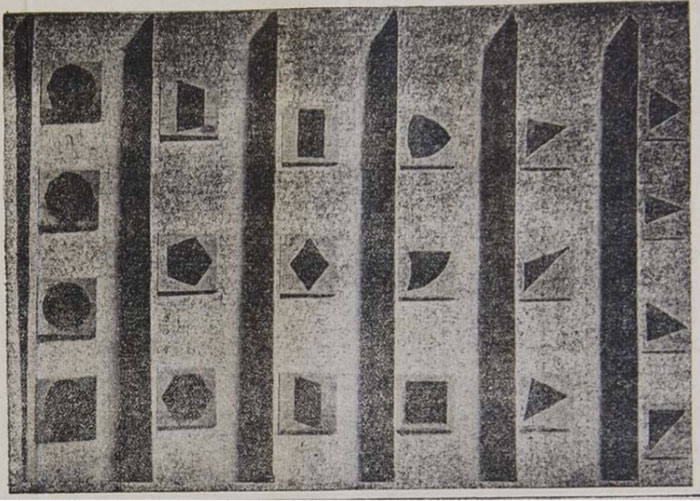
The figure above illustrates precisely how the children are to construct the geometric pieces, solid and void, independently, using different materials—for example, cardboard or wood of various colors—in such a way that the execution is so precise as to allow the two pieces to fit together with absolute perfection in the geometric inset. This means that the construction of the figures and the execution of the work must attainan exactness that is absolutely mathematical.
The pedagogical applications of the method thus briefly and imperfectly outlined are of singular importance. Here the classical method of Séguin, used for the intellectual education of the deficient, is rebuilt anew by applying it to manual work; a method which may perhaps, in a not distant future, become the positive and rational pedagogical method to be used also for all the normal.
To repeat! That is what has been lacking in all our old pedagogy, which nevertheless prepared us, even in practical life, to be superficial. To repeat means to deepen: by repeating one meditates; by repeating one assimilates; by repeating one prepares within oneself creation. It is one of the most interesting experiments being carried out today in experimental psychology: that of showing a board of various figures—such as, for example, a button, a buckle, a portrait, a ribbon, and so on—or of showing a picture, and then removing the object from view and inviting the observer to describe it.
Everyone sees more or less partially and poorly: some, indeed, in their descriptions invent out of whole cloth. This means that reality always reaches us only partially, and moreover mixed with illusions, when we observe in passing. What, in fact, remains with us of a book read in haste, of a university course followed at full gallop? — Little, but not only little; what remains with us are illusions; reality, the truth, the essence of the thing has almost completely been lost in our intellectual flight; we remained fatigued, but untouched. We lost strength, without gaining much. One must stop, and repeat.
Experimental science, so much extolled and so fruitful in progress, what has it done if not to compel human attention to linger, by means of objects that require the patient application of experiments? Truth demands a laborious conquest, a cultivation; it does not wish to be snatched in flight. — And the human personality, too, builds itself and grows only at the price of patience, of stopping, of repeating.
To return to an ancient comparison, the dewdrop shines, where it rests, like an illusory, ephemeral diamond, which the first insect, the first ray of sun, the first waft of wind disperses into nothingness; but the constant drop that falls can wear away granite.
In us, however, repetition does not produce only an almost mechanical fact, such as, for example, providing a granite-like memory of objects: repetition creates—it is the small and simple seed (the notion) which, left in fertile soil (our soul), germinates into plants that are surprises of new forms, creations, life.
The Jesuits conquered the world in their time by calling men who wandered, flitting among verses and courts, to meditation: to meditate is to pause with one’s thought, intensifying it, polarizing it upon the object of meditation. Thus, to read a book in a single night is an arid consumption of ourselves; to meditate for half an hour in the morning is to allow a free expansion of our ego, which for the most part remains badly suffocated beneath an avalanche of uncoordinated sensations. We do not know the art of expanding ourselves, nor do we know how to regulate our activities; for this reason, even those who are by nature strong and normal may come to weaken and fall out of balance, perhaps into neurasthenia.
Here, instead, in the procedures of scientific pedagogy, the task is not only to preserve intact and to develop strong individuals, but also to reconstruct oscillating personalities amid the imbalances of degeneration and morbid conditions.
Therefore, it is fitting to repeat. Who does not know that the abnormal have sensations different from ours? Colors, tastes, odors, tactile, thermal, and painful impressions are different in them. They possess such a different way of perceiving the world that the abnormal child appears to us almost always as a cynical liar, who denies or distorts the truth. For them, to pass fleetingly over things is not only to acquire illusions, but also truly “false perceptions” capable of constructing a mentality that is fatally pathological.
It is therefore necessary that real objects persist, insist, open a path for themselves, and fix a place for themselves in the minds of the abnormal. — Thus the logical gradation, repeated many times in exercises leading from geometry to real objects, constructs a complex thought by fixing it on exact and concrete notions.
The difficulty of the method lies precisely in repeating without boring, that is, without tiring. For in the end it is a matter of fixing attention for a long time upon a single thing, of dissecting it in all its depth. But this is precisely what is difficult with children in general, who are unstable, because their attention is quickly exhausted; and it appears all the more an arduous process in the degenerate, in the deficient, in all forms of abnormal mentality, from the epileptoid to the imbecilic; because the psychic characteristic of these minus habens [“one who has less”] is precisely the excessive instability of attention and the easy exhaustibility of effort; for which reason the degenerate change occupation at every moment and then end by becoming parasites. The difficulty is overcome in this, which seems a paradox: to repeat, by varying. Whoever observes the imposing number of different instruments that the small inmates of St. Michele must successively handle, as they pass through the working of materials as dissimilar as clay, cardboard, wood, and iron, will be left with the impression that the aim has been happily achieved.
Multiplicity so completely surrounds unity, instability so thoroughly frames constancy, that the child—while following the psychological needs of his unstable mind, while continually varying—fixes that determinate organic series of notions. And he does not tire, nor strain himself, nor exhaust himself. On the contrary, his personality comes to be, as it were, reordered and reconstructed: it is that manual work which, according to Benedikt, cures the nervous system and heals epilepsy.
Meanwhile, as the children pass from one form of work to another—leading them from the tenuous pliancy of modeling in clay to the hard and laborious operations of construction in iron—they display varied tendencies in the different skills of handling.
We must make workers of them all, who will one day have to be productive in professional application. Within the Reformatory itself, five workshops or laboratories await the small graduates of the school of educative manual work, in order to make workers of them: they may become blacksmiths, or carpenters, or artists (if they go to the modeling workshop), or also tailors or shoemakers.
All this changing of technique in the preparatory work must aim to spare the uncertainties of choice and the vain losses of failed trials. The child who has reached the end of the preparatory period finds himself on the threshold of a door that is for him a secure haven for remunerative work. The teacher must therefore continually study the individual tendencies of the small pupils.
Those who took delight in gently incising the obedient clay with slender little sticks, and felt irritation when handling the files amid the shrill sounds; those others who seemed, as it were, in their proper place before the lathe, yet grew bored while carving cardboard; those who experienced a singular pleasure in handling the scissors or in combining the ruler and the set square—did not amount (as still uselessly occurs in our common schools) merely to a vain and illogical accumulation now of praise and now of punishments; rather, they continued to manifest their own tendencies and indicated to the teacher the path of life for which they were suited. Thus they advanced simultaneously toward healing and toward their goal.
One day, when our Reformatories shall have been completely renewed in the direction already begun, and shall also have been able to provide an indispensable hygienic foundation for the premises and for the entire environment—so that fresh air and sunlight may physiologically revive the weakened organisms of the little proletarians—we shall truly be able to say that the whole preparatory or educational part of work leads toward the workshops of the healed, or rather of the convalescents. Certainly, persons so logically educated could not with real usefulness enter immediately into common workshops together with healthy and normal workers.
I call convalescents those boys who are in the professional workshops—also because it seems to me that the treatment due to them is comparable to that which we apply to one who, saved from a mortal illness, must regain strength in order to return among the living of active life.
The future teacher of these, who represent weakness within the fabric of humanity, could not be a workshop master or a harsh master. The heads of the crafts, too, must be educators, therefore distant from any interest in immediate profit and from every temptation of exploitation: teachers, in the true sense of the word, proud of the method, of the improvement of the pupils, and above all sensitive to their own high mission.
As is the case, for example, at St. Michele with Gèmini, a true and refined artist in sculpture and carving—who trains under his guidance small artists, joyful and smiling with pride in their own work; as is the case with the master tailor, Prandi, who has created a truly admirable method of progression—from the simple stitch to primitive works, to drawing, to cutting; as is Mulzone, the master blacksmith, so excellent in the difficult work of secret locks and safes, and who knows how to bring forth the most elegant furniture in iron, while his paternal gentleness seems a living contrast with the material of his work; and Mencarelli, the master carpenter, who follows the methods of Swedish work in progressive exercises from joinery to the construction of furniture; and Vinci, the master shoemaker, who, after teaching the first stitches, has originally divided the shoe into many parts that must be worked successively, such as the toe and the heel.
Thus it was that, in visiting the workshops, I was involuntarily led to think of what I had seen and admired in London in the marvelous organization of the auxiliary classes for the deficient: after special education in separate classes, the deficient pass on to central schools of work—that is, workshops—which have the specific purpose of teaching professional work by means of a rational pedagogical method.
Indeed, in England everything is taught: to be nursemaids or servants, just as to be teachers or professors, one must have completed a course of study and acquired a skill. With us, by contrast, preparation for life is aristocratic; those who do not attend higher schools or the University find no places that prepare them methodically for what they will have to do in the world. And for this reason manual labor is substandard; and to obtain a worker capable of building a hygienic room, or a bonne who knows how to hold a child in her arms, one must resort to England…
A complete rational school of work is therefore something economically and civically important for us, and worthy of being generalized. Why leave it hidden and confined within the Reformatory of St. Michele?