


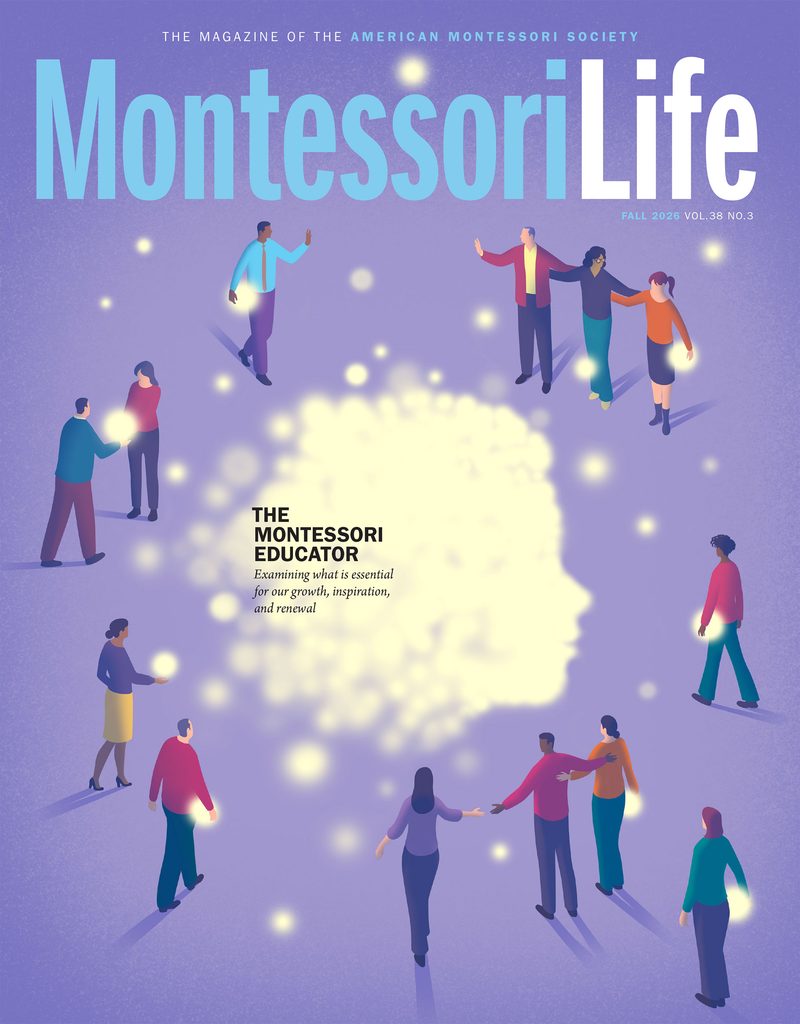
This article was featured in our Fall 2026 edition of Montessori Life magazine. Read the full issue online (AMS members only).
AMS members also receive a print subscription to Montessori Life magazine. Become a member today to receive your own subscription plus access to the complete digital archives.
By Elizabeth Willis, PhD
Maria Montessori described the teacher as “a spiritual servant whose work is not to fill minds but to awaken life” (Education and Peace, 1949/1972). Within this deceptively simple statement lies the foundation of an entire cosmology of education, one that views teaching not as a profession of delivery but as a sacred vocation of becoming. To teach, in Montessori’s understanding, is to participate in the unfolding of life itself. The teacher stands not above the child but alongside them, both learners in an evolving field of consciousness.
In contemporary educational discourse, teaching is often framed in terms of skill, competence, and measurable outcomes. Yet Montessori challenged this reduction long before such language entered the field. She envisioned the teacher as one who must prepare not only the environment and the lesson but also the self. The prepared teacher, in her view, embodies humility, observation, and reverence, qualities that arise not from technique but from inner transformation.
This inner preparation situates teaching within what might be called a sacred path of service. Though the outer form of the work may appear ordinary, guiding children through the rhythms of daily activity, the inner gesture of the teacher is profoundly spiritual. It demands an ongoing refinement of perception, an openness to wonder, and a willingness to be changed by the child. Montessori understood this mutual transformation as essential to education’s higher purpose: the evolution of humanity through the development of consciousness (Montessori, 1936/1966).
Today, as educators seek renewal amid fatigue, fragmentation, and systemic strain, Montessori’s call to prepare the spirit carries renewed relevance. The movement for teacher wellness echoes her insight that the teacher’s inner life is inseparable from professional effectiveness. To tend to one’s own soul is not an indulgence but an act of service to the child and the world.
It is here, at the intersection of pedagogy and presence, that the modern educator may rediscover what Montessori called “the true preparation of the teacher”: the awakening of the self as an instrument of peace (Montessori, 1949/1972, p. 132).
The Prepared Teacher and the Spiritual Foundation of Montessori Education—Beyond Competence
Maria Montessori’s vision of the prepared teacher stands at the center of her educational philosophy. She saw the teacher not as a transmitter of knowledge but as a participant in the evolutionary unfolding of life. The preparation of the teacher, therefore, could never be reduced to the mastery of method or curriculum. Montessori identified three interdependent dimensions of preparation—intellectual, methodological, and spiritual—each necessary for the teacher to perceive and respond to the child’s developing consciousness (Montessori, 1949/1967).
Montessori observed that children absorb not merely what adults say, but who adults are. She described this process as “unconscious absorption,” in which the child internalizes the tone, rhythm, and essence of the adult’s state of being.
While intellectual study ensures an understanding of human development and the scientific basis of her pedagogy, and methodological practice refines the delivery of lessons and materials, Montessori emphasized that neither could succeed without the preparation of the spirit. “The training of the teacher who is to help life is something far more than the learning of ideas,” she wrote; “it includes the training of character” (Montessori, 1949/1967, p. 131). For Montessori, this spiritual discipline required humility, patience, and the relinquishment of ego so that the teacher might perceive the child without distortion. The work of teaching thus becomes a moral and spiritual apprenticeship, a continual practice of self-refinement.
In The Discovery of the Child (1948/1967), Montessori urged educators to “cast aside all prejudices and preconceptions” (p. 10) and engage in a “continual transformation” of the self (p. 151). This transformation was not theoretical but experiential. The teacher was to develop inner stillness and self-awareness through observation of children, learning to respond with equanimity rather than impulse. The prepared teacher, therefore, becomes both scientist and mystic: scientifically attentive to phenomena, yet spiritually attuned to the unseen dimensions of human development.
Montessori extended this interior preparation beyond the classroom to the broader aim of human evolution. In Education and Peace (1949/1972), she described educators as “ambassadors of humanity” whose inner equilibrium contributes to the peace of the world (p. 94). Such equilibrium arises when the teacher’s consciousness aligns with the “inner directive force of life,” the vital principle guiding growth and adaptation (Montessori, 1949/1972, p. 95). To teach, then, is to enter a sacred covenant with this universal movement—to cooperate with the life force that animates both the child and
the cosmos.
Modern research increasingly validates Montessori’s early insight that the teacher’s inner state directly influences the child’s learning environment. Contemporary neuroscience describes how children internalize not only information but also the adult’s emotional and physiological patterns. Through mechanisms of co-regulation and mirror neurons, the teacher’s nervous system becomes a living model of safety, curiosity, and order—a stabilizing field for the child’s nervous system (Levine, 2008). Thus, the preparation of the spirit can also be understood as the cultivation of coherent presence, a physiological and psychological state through which peace becomes perceptible.
This interpretation reframes Montessori’s spiritual preparation as the original foundation of what is now termed teacher wellness. Competence pertains to what the teacher does; consciousness concerns how the teacher is. Montessori anticipated this distinction, writing that “the success of the teacher lies in the inner calm with which she watches the child’s work” (The Absorbent Mind, 1949/1967, p. 269). Her framework reminds us that true wellness cannot be reduced to self-care strategies alone. It emerges from alignment between the teacher’s inner life and outward practice, from the understanding that professional renewal and spiritual preparation are one and the same.
Through this synthesis, Montessori positioned the teacher as both exemplar and environment. I propose that the teacher’s presence—regulated, reverent, and aware—constitutes the most essential material of the classroom. In this way, Montessori anticipated a view of education that is not only developmental but incarnational: The consciousness of the adult shapes the atmosphere through which the child’s soul takes form.
Teaching as a Soul-to-Soul Transmission
At the heart of Montessori’s pedagogy lies a profound recognition of reciprocity between teacher and child. Education, she wrote, “must be a help to life” (Montessori, 1949/1967, p. 10), a phrase that encompasses not only the child’s life but the teacher’s as well. The relationship between them is not hierarchical but symbiotic, a continuous exchange of awareness and being. In this sense, Montessori anticipated a view of teaching as a soul-to-soul transmission: a dynamic field in which the consciousness of the adult and the consciousness of the child shape one another in mutual evolution.
Montessori observed that children absorb not merely what adults say but who adults are. She described this process as “unconscious absorption,” in which the child internalizes the tone, rhythm, and essence of the adult’s state of being (Montessori, 1936/1966). This subtle transmission of presence forms what might be called the unseen curriculum of every classroom. “The teacher’s mission,” Montessori wrote, “has always been to serve humanity, not merely by transmitting knowledge, but by revealing the higher laws of life” (Montessori, 1949/1972, p. 99). The teacher’s presence, regulated, attuned, and coherent, becomes a
living environment through which the child encounters these higher laws.
This phenomenon is perhaps best illustrated through an experience I had in the classroom many years ago.
I remember the moment I first saw a child’s soul.
It was about three years into teaching. I was mid-conversation with a young student when something in me shifted.
For the first time, I paused, not just externally, but internally. I let go of the habitual busyness of “teacher mode,” took a breath, and dropped into my body.
Everything around us seemed to slow. And then, as I met her gaze, time suspended altogether.
In that stillness, I looked directly into her eyes and felt myself falling into something vast, something ancient, something unspoken. I realized then that I could see through her eyes into her soul.
And I could feel her soul speaking to me:
“Why are you making me move so fast? What is going on here?
I’m just trying to understand.
Can you see my pain?
Can you see me trying?
Can you see me?”
And my soul, without hesitation, responded: “Yes. I see you. I am here for you. I get it.”
This conversation didn’t happen out loud, at least not in the usual way. It happened in the quiet fabric of a millisecond, a sacred thread of presence woven between us.
As she continued to speak with her voice, I stayed with the soul beneath the words. I held the gaze, held the frequency. I listened not only to what she said, but to what she meant. I didn’t rush to fix.
I didn’t launch forward in my usual “get it done” mode. I didn’t use a strategy. I simply met her, soul to soul.
The dialogue that followed was minimal in words but monumental in impact. It nourished both of us. That moment marked a profound shift in my teaching. From then on, I found that when I was able to drop into soul connection, everything else softened. Urgency dissolved. Behavior management strategies became irrelevant.
What once drained me began to fill me. There was no need for repetition or control, the transmission was energetic, relational, immediate.
The experience left me feeling deeply fulfilled and even a little awed. I realized then that the soul responds instinctively to being seen, and the child softens when their essence is met. In that moment, I understood that this is the essence at the core of all true relating, the universal yearning we all carry to be recognized in the truth of our being.
This encounter exemplifies Montessori’s spiritual science in practice. The teacher’s transformation arises not through external mastery, but through presence, through learning to perceive beneath behavior and intellect to the deeper movement of life within the child. In that shared stillness, the adult fulfills what Montessori described as “the awakening of love,” an act in which the teacher becomes the child’s mirror of wholeness (Montessori, 1949/1967, p. 276).
A grounded, compassionate adult transmits a sense of safety that allows the child’s curiosity and self-regulation to unfold naturally. Thus, the prepared teacher is not simply one who knows, but one who is, whose inner coherence becomes the silent pedagogy of peace.
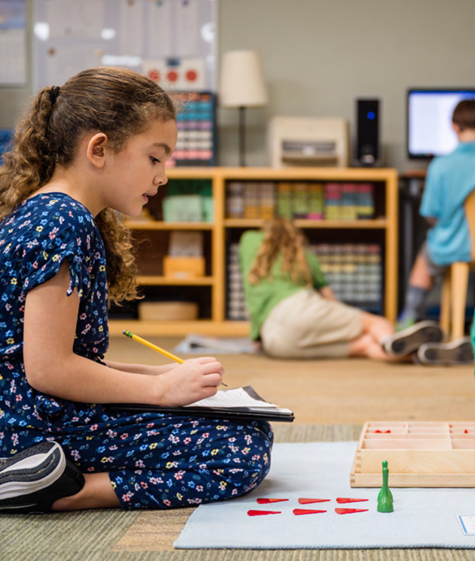
To teach soul to soul, then, is to participate in the sacred reciprocity that underlies all genuine education. The child’s unfolding calls forth the adult’s awareness just as the adult’s awareness shelters the child’s becoming. In this relational field, where science meets spirit, and method becomes meditation, education reveals its true nature: not as performance but
as presence.
Teacher Wellness and Professional Renewal as Intertwined Pathways
Montessori’s concept of the prepared teacher anticipated by decades the modern conversation about teacher wellness and professional renewal. Long before the emergence of terms such as self-care or mindfulness, Montessori recognized that the quality of education depends on the inner equilibrium of the adult. “The teacher must prepare herself spiritually,” she wrote, “not merely to understand the child, but to create within herself an environment of peace and order” (Montessori, 1949/1967, p. 149). For Montessori, wellness was not a supplemental ideal but the very ground of pedagogy.
Today, educators across contexts face increasing emotional and systemic strain: rising workloads, technological acceleration, and the ongoing demand to meet children’s social-emotional needs. In this climate, wellness is often treated as an external intervention, an additional initiative layered atop already burdened schedules. Yet Montessori’s writings remind us that renewal cannot be imposed from without; it must arise from within. The teacher’s capacity for calm, empathy, and attunement is not a separate skill but an extension of spiritual preparation.
When the teacher is centered, the classroom atmosphere mirrors that coherence. As discussed before (Levine, 2008), human nervous systems regulate through relational resonance: A teacher’s embodied steadiness can help a child’s physiology return to balance after stress, which can then foster attention, curiosity, and joy in learning. In this sense, the Montessori classroom functions as a living organism; each individual’s state contributes to the collective rhythm of peace. Wellness, therefore, is not an individual luxury but an ecological necessity.
Montessori’s idea of the prepared environment extends naturally to the inner environment of the adult. Just as materials are arranged with precision to invite autonomy and exploration, the teacher’s inner life must be tended with the same care. Reflection, silence, and self-
observation become spiritual practices that regenerate the teacher’s sense of meaning. Through these practices, the adult realigns psyche (the inner life of thought and feeling) and soma (the living, sensing body), so that thought, feeling, and action once again move in harmony. This integration restores what Montessori (1949/1972, p. 261) called “the normal order of humanity,” an order grounded in love and presence.
Professional renewal, then, is not the recovery of efficiency but the remembrance of purpose. The teacher who reclaims stillness and embodiment participates in a subtle act of resistance against education’s mechanization. Wellness and spiritual preparation are, as
Montessori implied, inherently intertwined pathways: Both lead toward wholeness, coherence, and peace. When the teacher’s soul is tended, the classroom becomes a sanctuary, not only for learning but for healing—the place where humanity practices remembering itself.
The Future of the Prepared Teacher: Reuniting Psyche and Soma
In Montessori’s time, the notion of spiritual preparation was radical: It placed the inner life of the teacher at the center of educational reform. Today, this insight continues to evolve as educators and researchers explore how embodiment, nervous system awareness, and mindfulness intersect with pedagogy. The next frontier of Montessori’s vision may well lie in the reunion of psyche and soma—in the integration of the teacher’s psychological and physiological dimensions into one field of consciousness.
Professional renewal, then, is not the recovery of efficiency but the remembrance of purpose. The teacher who reclaims stillness and embodiment participates in a subtle
act of resistance against the mechanization of education.
Montessori’s writings often implied this unity, though the language of her era could not yet name it. She described the teacher as one who “must acquire a moral alertness, an inner equilibrium, and a spiritual strength that come from calm and collected thought” (Montessori, 1949/1967, p. 150). Implicit in this description is the understanding that thought, emotion, and body are not separate realms but interwoven expressions of being. When the psyche and the soma are harmonized, the teacher becomes
a fully prepared instrument, capable of perceiving the child not only with intellect, but with the whole of her presence.
Recent developments in somatic psychology echo this understanding. The body, once marginalized in pedagogical discourse, is now recognized as a site of wisdom and communication. Embodied awareness allows teachers to notice subtle cues in themselves and in children—breath, tension, posture—that reveal the invisible dynamics of relationship (Levine, 2008). When the teacher’s own body becomes a conscious instrument of perception rather than a vessel of exhaustion, education reclaims its original sacred function: to awaken life in all its forms.
To reunite psyche and soma is, therefore, to extend Montessori’s spiritual science of education into the modern era. It calls for a pedagogy of presence, one that honors both the scientific and the mystical, the measurable and the mysterious. In such a framework, professional renewal becomes synonymous with spiritual awakening; the care of the teacher’s body becomes an act of reverence for the soul that animates it.
This integration invites a new generation of Montessori educators to expand the meaning of preparation. Beyond mastering lessons and maintaining order, the prepared teacher of the future is one who embodies coherence: a state in which intellect, heart, and body align in service to life. As Montessori envisioned, education’s ultimate purpose is not merely to instruct, but to evolve consciousness. When the teacher stands in wholeness, psyche and soma intertwined, the classroom once again becomes what Montessori intended it to be: a living temple of peace.
ELIZABETH WILLIS, PhD (she/her), is a Montessori educator, author, keynote speaker, and founder of the New Paradigm Teaching Institute. She has spent over 25 years in Montessori classrooms and currently serves as an adjunct professor, as a Lower Elementary guide, and as guest faculty at numerous Montessori teacher education programs in Miami, FL. She is AMS-credentialed (Early Childhood, Lower Elementary, and Upper Elementary), and her doctorate is in Curriculum and Instruction in Early Childhood Education. She is the author of The Initiated Teacher: Reawakening the Soul of the Montessori Educator in the New Paradigm, a work exploring the inner preparation of the adult, embodiment, and teaching as a path of soul development. Contact Elizabeth at drelizabethwillis.com.
References
Levine, P. A. (2008). Healing trauma: A pioneering program for restoring the wisdom of
your body. Sounds True.
Montessori, M. (1966). The secret of childhood (B. Johnstone, Trans.). Ballantine Books.
(Original work published 1936)
Montessori, M. (1967). The absorbent mind (C. A. Claremont, Trans.). Holt, Rinehart
and Winston. (Original work published 1949)
Montessori, M. (1967). The discovery of the child (M. J. Costelloe, Trans.). Ballantine
Books. (Original work published 1948)
Montessori, M. (1972). Education and peace (H. R. Lane, Trans.). Henry Regnery
Company. (Original work published 1949)